


The Designer who Changed America | Ludwig Mies van der Rohe | Bauhaus Icon | Design Docs
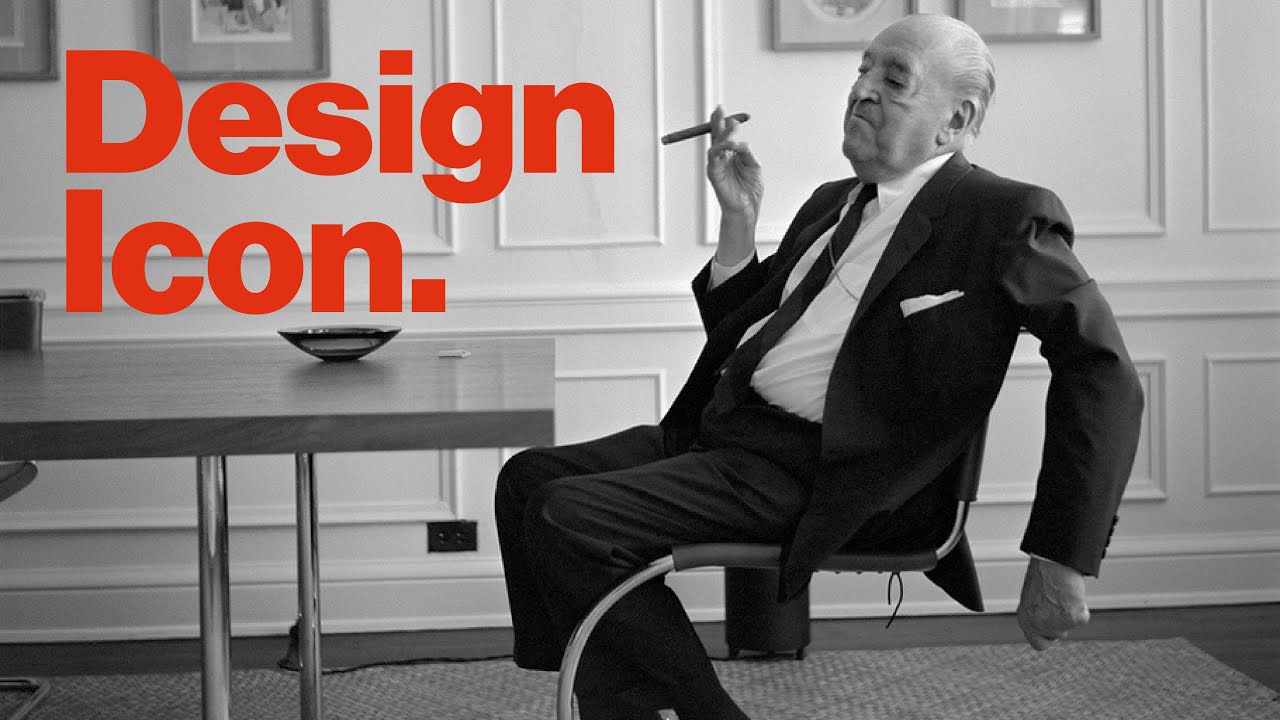
Ludwig Mies van der Rohe was an architect and designer from the early 1900s who was extremely influential in both fields as well as in the development of modernism, the international style, and the progression of the Bauhaus Movement. He developed some of the most iconic buildings of those styles in both the US and Germany, and dabbled in other areas of design such as furniture design. One of his most iconic works, the Barcelona Chair, is seen in countless big films, and is still produced today through a licensing deal with Miller Knoll. He is perhaps most well known for his ideas that “Less is More” and that “God is in the Details”, which are both extremely apparent in his work.
Born on March 27, 1886 to Maria Ludwig and Michael Mies, Ludwig Mies (he added his mother’s surname, van der Rohe, when he had established himself as an architect) was a German American architect and designer. As the son of a master stone mason, Mies had architectural influences in his life from a very early age. While he never received any formal architectural training in his early days, he was fortunate enough to assist his father on a number of job sites in his youth, giving him a strong understanding of what it means to build something.
At age 15, Mies apprenticed at a small architectural firm. Here he sketched ideas for architectural ornaments that would eventually be produced from stucco and come to decorate buildings. This would later become somewhat comical in the face of his radically minimal approach to architecture he would eventually develop. While divergent from his eventual path, the time at this firm helped develop his skill for linear drawings, which would eventually lead him to create some of the most beautiful architectural renderings of his time.
In 1905, Mies would move to Berlin at the age of 19 and become an apprentice to Bruno Paul, a well known furniture designer of that era who mainly practiced in the art nouveau style. He used that experience and his experience at the architecture firm to eventually receive his first commission in 1907 to guide the development of a somewhat traditional suburban house.
After an impressive architectural debut, Peter Behrens took notice of Mies. He would come to offer the 21 year old a job at his growing firm. Here he would become acquainted with others who would later develop the Bauhaus movement alongside him – Walter Gropius and Le Corbusier.
After World War I, while still designing relatively traditional neoclassical homes, Mies began an additional, more experimental effort. He joined forces with his progressive thinking peers in the long-running search for a new style that would mesh better in the modern industrial age. During this era, a number of what many would consider to be poor design decisions were being made. With new access to industrial building techniques, a rethinking of architectural approach was necessary. Since the mid 19th, less and less was hand made due to the Industrial Revolution. There was a time between where architects would try to replicate hand worked, ornate buildings of the past, but with modern technology, but there was something disingenuous and therefore not appealing about this approach. Mies and his colleagues sought truth in their practice, and would come to develop what is known as the international style as a result. Here they embraced modern industrial practices, and created froms that synergized with these new techniques rather than fighting against them. They had a real focus on truth to material and process.
Beyond their own stylistic preferences and design ethos, there was a growing social desire to change architectural direction after WW1. The aristocratic classical revival styles were particularly disdained by many as the architectural symbol of a now-discredited social system.
Progressive thinkers called for a completely renewed design process guided by rational problem-solving and a focus on truth to modern materials and structure over what they thought of as the superficial construction of classical, more ornate buildings.
While continuing his traditional design practice, Mies quickly began to develop a number of visionary projects that, though mostly unbuilt, rocketed him to fame as an architect capable of giving form that was harmoniously tied to the ethos of the emerging modern industrial society. Mies threw the ornamental design trends of the past to the wind, and made a powerful modernist debut in 1921 with his stunning competition proposal for the full glass Friedrichstraße skyscraper. He followed this up with a taller curved version in 1922 naming it the Glass Skyscraper.[16]
He constructed his first modernist house titled Villa Wolf in 1926 in Guben (today Gubin, Poland) for Erich and Elisabeth Wolf.[17] This was shortly followed by Haus Lange and Haus Esters in 1928.
Instagram: @bctld
Portfolio: productold.com
Accéder à la chaine Youtube